Buying the wrong size air conditioner is one of the most expensive mistakes you can make. Too small and the unit runs flat-out, never reaches your target temperature, and burns out years early. Too large and it short-cycles, leaves the room feeling damp and clammy, and wastes electricity. Getting the size right before you buy is the single most important decision in the entire process.
This guide gives you everything you need to correctly size an aircon for any room in a South African home or office — a quick-reference BTU table, a step-by-step calculation method, adjustment factors for South African conditions, room-by-room recommendations, and answers to the most common sizing questions buyers ask.
What Is BTU and Why Does It Matter?
BTU stands for British Thermal Unit — it is the standard measure of an air conditioner’s cooling (and heating) capacity. One BTU is the amount of energy needed to raise the temperature of one pound of water by one degree Fahrenheit. For aircons, it tells you how much heat the unit can remove from (or add to) a room per hour.
In South Africa, aircon capacity is expressed in two ways:
- BTU/hr — the traditional measure used on most product listings. Common sizes: 9,000 / 12,000 / 18,000 / 24,000 / 36,000 BTU.
- kW — the metric equivalent increasingly used on newer product specs. 1kW ≈ 3,412 BTU. So a 3.5kW unit = approximately 12,000 BTU.
Both are used interchangeably in South Africa. This guide uses BTU as the primary measure since that’s how most products are listed, with kW equivalents throughout.
Quick BTU Sizing Table for South Africa (2026)
This table gives you a reliable starting point for standard South African rooms with average insulation and ceiling height of 2.4–2.7m:
| Room Size | BTU | kW | Approx. Price | Typical Room Type |
| Up to 10m² | 7,000 BTU | 2.0kW | R5,000–R8,000 | Very small bedroom, server room, bathroom |
| 10–15m² | 9,000 BTU | 2.5kW | R6,500–R11,000 | Small bedroom, study, home office |
| 15–25m² | 12,000 BTU | 3.5kW | R8,000–R14,000 | Master bedroom, standard lounge, medium office |
| 25–35m² | 18,000 BTU | 5.0kW | R11,000–R18,000 | Large lounge, open-plan dining room |
| 35–50m² | 24,000 BTU | 7.0kW | R15,000–R24,000 | Large open-plan, small commercial space |
| 50–70m² | 36,000 BTU | 10kW | R22,000–R35,000 | Large commercial, open office, restaurant |
| 70m²+ | Custom | 12kW+ | Quote required | Consult an HVAC professional for assessment |
The highlighted row (12,000 BTU) covers the most common room size in South African homes. When in doubt between two sizes, always go up — an oversized unit can be managed; an undersized one cannot.
Step-by-Step: How to Calculate the Right Aircon Size
The quick table above is a reliable guide for standard conditions. For a more precise calculation, follow these four steps:
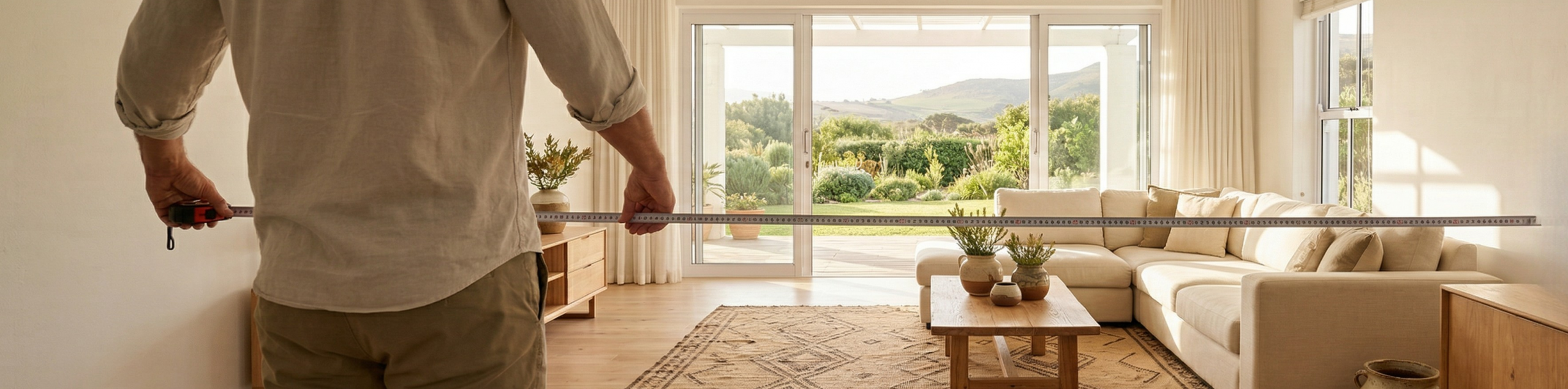
Step 1: Measure your room area
Multiply the length of the room by the width to get the floor area in square metres.
| Example
Room is 5m long x 4m wide = 20m² floor area. |
Step 2: Apply the base BTU formula
The standard starting formula used by HVAC professionals:
| Required BTU = Room Area (m²) × 500
Example: 20m² × 500 = 10,000 BTU → round up to 12,000 BTU |
Step 3: Adjust for South African conditions
The base formula assumes a temperate climate with good insulation. South Africa’s diverse climate zones and common construction styles require adjustments. Add or subtract the following from your Step 2 result:
| Condition | Adjustment | Why |
| Hot climate zone (Limpopo, Mpumalanga, Northern Cape, Lowveld) | +15–25% | Higher ambient temperatures increase cooling load |
| Mild/coastal climate (Cape Town, parts of KZN coast) | −5–10% | Lower peak temperatures reduce cooling demand |
| Highveld (Johannesburg, Pretoria) | Base rate | Standard formula applies well to highveld conditions |
| Large west- or north-facing windows | +10–15% | Afternoon sun load adds significant heat gain |
| Tin, IBR, or flat concrete roof with no ceiling insulation | +20–30% | Uninsulated roofs dramatically increase cooling load |
| Well-insulated ceiling (150mm+ insulation) | −5–10% | Good insulation reduces heat gain and cooling demand |
| Ceiling height above 3.0m | +10–20% | Greater air volume to condition increases BTU requirement |
| Room with 5+ people regularly (office, classroom) | +600 BTU per person above 2 | Human bodies generate approximately 600 BTU/hr |
| Kitchen or room with significant heat-generating equipment | +20–40% | Stoves, ovens, servers, and machinery add substantial load |
| South-facing room (receives least direct sun) | −5% | Less solar heat gain reduces cooling requirement slightly |
Step 4: Match to the nearest standard BTU size
Round your adjusted figure up to the nearest standard aircon size. Standard BTU sizes available in South Africa: 7,000 / 9,000 / 12,000 / 18,000 / 24,000 / 36,000 BTU. Always round up, never down.
| Worked Example
20m² room in Polokwane (hot climate), north-facing window, standard ceiling height, no insulation. Base: 20 × 500 = 10,000 BTU + Hot climate (+20%): +2,000 BTU + North-facing window (+12%): +1,200 BTU + No ceiling insulation (+25%): +2,500 BTU Total: 15,700 BTU → Round up to 18,000 BTU The quick table suggested 12,000 BTU for 20m² — correct for Johannesburg with standard insulation, but significantly undersized for Polokwane without insulation. |
Room-by-Room Sizing Guide for South African Homes
Bedroom
Bedrooms are where aircon sizing matters most — you’re sleeping in the conditioned space, so both undersizing (too warm) and oversizing (too cold and humid) affect sleep quality directly.
- Small bedroom (up to 12m²): 9,000 BTU. Covers a standard single or small double bedroom.
- Standard master bedroom (12–20m²): 9,000–12,000 BTU depending on window exposure and insulation.
- Large master bedroom with en-suite (20–28m²): 12,000–18,000 BTU. Include the en-suite area in your total m² if the bathroom door stays open.
| Bedroom Oversizing Warning
An oversized aircon in a bedroom short-cycles — it cools the air rapidly but doesn’t run long enough to remove humidity. The result is air that feels cold and clammy rather than cool and comfortable. If anything, size bedrooms conservatively. |
Lounge / Living Room
The lounge is typically the most demanding room to size because of its open layout, large windows, and connection to other areas. Always measure the actual floor area you want to condition, and account for open-plan connections.
- Small lounge (up to 20m²): 12,000 BTU.
- Standard lounge (20–35m²): 18,000 BTU.
- Large lounge or open-plan (35–55m²): 24,000 BTU.
- Open-plan kitchen/dining/lounge (55m²+): 36,000 BTU, or consider a multi-split system with separate units per zone.
Home Office / Study
Home offices are usually easier to size — smaller rooms with one or two occupants and computer equipment. Add 600 BTU per person beyond the first two, and account for the heat generated by multiple screens and computers.
- Small home office (up to 15m², 1–2 people): 9,000 BTU.
- Medium home office (15–25m², 2–4 people): 12,000 BTU.
- Larger office / server room: Add 20–40% to the base BTU for significant server or IT equipment heat load.
Kitchen
Kitchens are the most challenging room to cool in a South African home due to the heat generated by cooking appliances. Most residential kitchens are better served by good extraction ventilation (extractor fans or hoods) combined with aircon in the adjacent open-plan area, rather than a dedicated kitchen aircon.
If you do need aircon in a kitchen or open-plan kitchen area: add 30–40% to the base BTU to account for cooking heat load. A 25m² open-plan kitchen that would normally need 12,000 BTU may require 16,000–17,000 BTU — round up to 18,000 BTU.
Commercial Office Space
Open-plan commercial offices have higher heat loads per square metre due to occupancy density, lighting, and equipment. Use this adjusted formula for commercial spaces:
| Space Type | BTU per m² | Notes |
| Standard residential room | 500 BTU/m² | Base formula — single occupant, standard equipment |
| Home office (2–3 people) | 600 BTU/m² | Add for occupancy and computer equipment |
| Open-plan office (4+ people) | 700 BTU/m² | High occupancy density, significant equipment heat load |
| Retail shop | 600–700 BTU/m² | Varies by lighting type and customer traffic |
| Restaurant / food service | 800–900 BTU/m² | Cooking equipment, high occupancy, frequent door opening |
| Server room / data room | Custom load calc | Consult an HVAC professional — standard formulas do not apply |
South African Climate Zones and Aircon Sizing
South Africa spans multiple climate zones, and the same room in different cities can require dramatically different aircon capacity. Here’s how major cities map to sizing adjustments:
| City / Region | Climate Type | Size Adjustment | Key Factor |
| Johannesburg / Pretoria | Highveld / Semi-arid | Base rate | Hot summers, mild winters, afternoon thunderstorms |
| Cape Town | Mediterranean | −5–10% | Mild summers; winter heating matters more than cooling |
| Durban / KZN coast | Subtropical / Humid | +10–15% | High humidity increases effective heat load significantly |
| Polokwane / Limpopo | Hot semi-arid | +20–25% | Very high summer temperatures; size up significantly |
| Nelspruit / Lowveld | Hot & humid | +20–30% | Combination of heat and humidity is the most demanding |
| Port Elizabeth / Gqeberha | Moderate maritime | Base −5% | Moderate temperatures year-round; mild sizing |
| Bloemfontein | Semi-arid continental | Base +5% | Hot dry summers; cold winters — heat pump capability matters |
| George / Garden Route | Temperate / Coastal | −5–10% | Mild climate; moderate cooling requirement |
Humidity is a critical and often overlooked factor. In humid climates like Durban and the Lowveld, your aircon must do two jobs: lower the temperature AND remove moisture from the air. An undersized unit in a humid climate will cool inadequately and leave the air feeling heavy and uncomfortable even at the target temperature.
What Happens If You Get the Size Wrong?
Too Small: What Undersizing Looks Like
- The unit runs continuously at maximum capacity without ever reaching your set temperature on very hot days.
- Compressor wear accelerates because the unit never gets to rest — lifespan is significantly shortened.
- Electricity bills are higher than a correctly sized unit, because the compressor runs flat-out constantly.
- The room never feels truly comfortable on the hottest days when you need cooling most.
Too Large: What Oversizing Looks Like
- Short-cycling: the unit reaches the set temperature in minutes and shuts off, then the temperature rises and it restarts. This cycle repeats constantly.
- Poor dehumidification: moisture removal requires sustained operation. A short-cycling unit doesn’t run long enough to properly dehumidify, leaving the air feeling cold and clammy.
- Temperature swings: the room oscillates between too cold and too warm rather than maintaining a stable comfortable temperature.
- Higher wear on the compressor: the start-up phase is the most mechanically stressful moment; frequent short-cycling causes premature wear.
Sizing for Heating: Using Your Aircon as a Heat Pump
Most modern inverter aircons are reverse-cycle units — they can heat as well as cool. This makes them effective (and efficient) heaters in winter, which is particularly relevant for Johannesburg, Pretoria, Bloemfontein, and the Cape winelands where winters can be cold.
Heating BTU requirements are generally similar to cooling requirements for the same room, with one important difference: heat loss through walls, windows, and doors matters more in a poorly insulated home in winter than solar heat gain in summer. The adjustment factors are:
- Well-insulated home: same BTU size as your cooling requirement.
- Poorly insulated home (single brick, large windows, draughty): size up by one BTU category for effective winter heating.
- Very cold winter climate (Sutherland, Drakensberg foothills, highveld frost zones): size up by one category and confirm the unit’s minimum operating temperature (most inverter aircons heat effectively down to −15°C ambient).
5 Aircon Sizing Mistakes to Avoid
- Measuring only one room when you want to cool an open-plan area. If your lounge, dining room, and kitchen are all open to each other, measure the total combined floor area — not just the lounge portion.
- Ignoring ceiling height. The standard formula assumes a 2.4–2.7m ceiling. A room with 3.5m ceilings has considerably more air volume to condition. Add 15–20% to your BTU figure.
- Not accounting for the roof. A room directly under an uninsulated tin or flat concrete roof in summer is one of the most demanding environments an aircon can face. Add at least 25–30% to the base BTU requirement.
- Assuming the same size works in every city. A 12,000 BTU unit that’s perfect for a Johannesburg bedroom may be significantly undersized for the same room in Nelspruit or Polokwane.
- Using BTU figures from international websites. US and UK sizing guides are calibrated for temperate Northern Hemisphere climates. South Africa’s sun intensity, ambient temperatures, and building construction styles all push sizing requirements higher than international guides suggest.
Frequently Asked Questions
What size aircon do I need for a 20m² room?
For a standard 20m² room in Johannesburg or Pretoria with average insulation and a normal ceiling height, a 12,000 BTU (3.5kW) inverter aircon is the right choice. If the room is in a hotter climate (Polokwane, Nelspruit), faces west or north with large windows, or has a poorly insulated roof, step up to an 18,000 BTU unit.
What size aircon do I need for a 30m² room?
A 30m² room under standard conditions requires an 18,000 BTU (5kW) unit. In a hot or humid climate with poor insulation, consider a 24,000 BTU unit instead. If the room is part of a larger open-plan area, measure the total combined floor area rather than just the 30m² section.
Is 12,000 BTU enough for a lounge?
For a small to medium lounge of up to 20–22m² in a temperate climate with good insulation, yes. For larger lounges, open-plan areas, or rooms in hotter climates, 18,000 or 24,000 BTU is more appropriate. The most common undersizing mistake in South African homes is fitting a 12,000 BTU unit in a 30–35m² open-plan lounge.
Can I use one aircon for multiple rooms?
A single wall-split unit can only effectively condition the room it’s installed in, plus immediately adjacent open areas. For multiple separate rooms, a multi-split system (one outdoor compressor, multiple indoor units) is the right solution. Alternatively, separate single-split units per room give you independent temperature control in each space.
How do I size an aircon for an open-plan area?
Measure the total floor area of the entire open-plan space, including the kitchen, dining room, and lounge if they’re all open to each other. Apply the base formula (area × 500) and then add the kitchen adjustment (+30–40%) if cooking appliances are in the space. A 50m² open-plan kitchen/dining/lounge in Johannesburg typically requires a 36,000 BTU unit or a multi-split system.
Should I go bigger or smaller if I’m between two sizes?
Always go up to the next size. The consequences of undersizing (unit runs flat-out, room never reaches target temperature, premature compressor failure) are worse than mild oversizing. That said, avoid jumping two sizes up — significant oversizing causes short-cycling and poor dehumidification. One size up is the safe approach.
Not Sure? Let AC Direct Help You Size It
Getting the BTU right before you buy is the most important step — and it’s one our team does every day. AC Direct stocks the full range of inverter wall-split aircons from 9,000 to 36,000 BTU across all major brands.
- Browse by BTU size to find the right unit for your room
- Compare brands at each BTU rating side by side
- Add professional installation at checkout
Already know your BTU? Shop our wall-split range by size and find the right unit at the right price, delivered across South Africa.