

Solar vs Eskom: Who Wins Long Term?
Solar vs Eskom: Who Wins Long Term?
If your prepaid electricity disappears faster every month, the question is no longer just whether solar works. The real question is whether staying fully dependent on Eskom still makes financial sense over the next five to ten years.
The honest answer is this: Eskom is cheaper to start with because there is no equipment to buy, but solar gives you more control over what you pay for electricity over time. A correctly sized solar system can reduce grid dependence, protect you from future tariff pressure, and keep essential appliances running when the grid is unstable. A badly sized system, however, can cost more than it saves.
This guide compares solar vs Eskom electricity in South Africa from a practical homeowner and small-business point of view. We’ll look at cost, reliability, prepaid electricity, batteries, carbon footprint, and what type of solar setup makes the most sense.
Solar vs Eskom: Quick Comparison
| Factor | Eskom / Municipal Electricity | Solar Power |
|---|---|---|
| Upfront cost | No system cost | Higher upfront cost or monthly finance |
| Monthly cost | Ongoing and tariff-dependent | Lower grid use once installed |
| Price control | Low — tariffs can increase | Better — system cost is more predictable |
| Reliability | Depends on grid performance | Stronger with battery backup |
| Best use case | Low-use homes, renters, simple supply | Homes and businesses with medium to high usage |
| Backup during outages | None unless paired with generator/inverter | Yes, if designed as a hybrid or off-grid system |
| Maintenance | Grid maintained externally | Panels, inverter and batteries need checks |
| Environmental impact | Still heavily coal-linked | Clean generation at the point of use |
| Long-term asset value | No owned energy asset | Owned system can add practical home value |
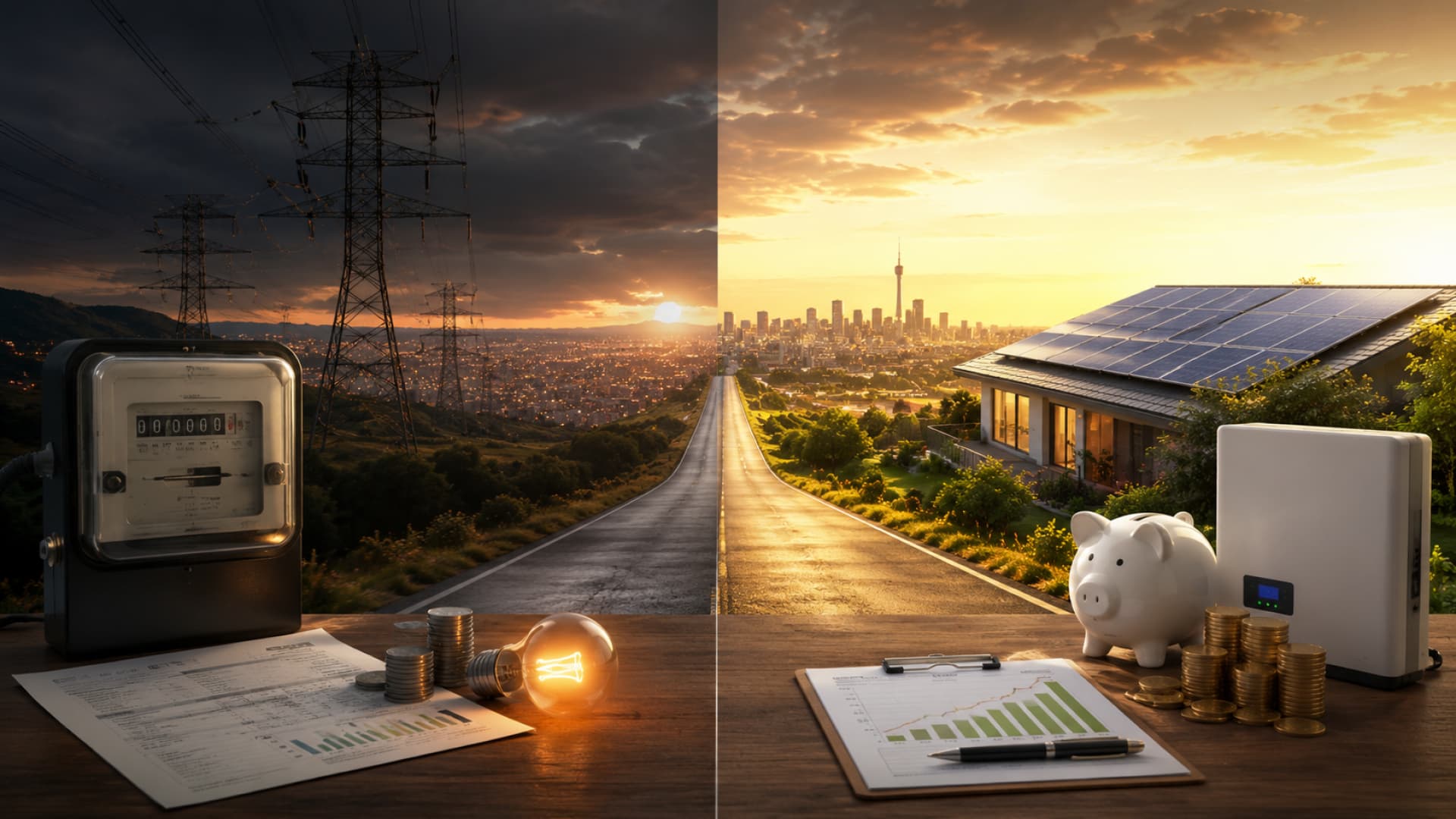
The winner depends on what you are comparing. For zero upfront effort, Eskom wins. For long-term control, predictable energy planning and reduced grid reliance, solar usually wins when the system is correctly sized and properly installed.
What Eskom Still Does Well
It is easy to turn “solar vs Eskom” into a one-sided argument, but that is not useful. Eskom or municipal electricity still has advantages.
You do not need to buy equipment, maintain panels, replace batteries, or plan your household loads around a system design. You pay for what you use, and the grid can supply high-demand appliances without you worrying about inverter capacity, battery charge or solar production.
For a low-use household, a renter, or a property with very limited roof space, a full solar system may not make financial sense immediately. In those cases, a smaller backup inverter, efficient appliances, a heat pump, or better load management may be the smarter first step.
Where Eskom becomes painful is over time. You are exposed to tariff increases, municipal billing differences, prepaid top-ups, power quality issues, and the possibility of power cuts returning during periods of grid stress. You are also paying for electricity every month without building ownership of an energy asset.
Where Eskom Hurts Over the Long Run
The biggest issue with Eskom electricity is not only the current price. It is the lack of control.
Most South African households have already felt this. A prepaid top-up that once lasted comfortably now disappears faster. Businesses feel it even more when energy costs cut into margins, especially for refrigeration, heating, cooling, pumps, machinery, kitchens, offices and production spaces.
Eskom direct tariffs increased by 12.74% from 1 April 2025, while municipal bulk purchase tariffs increased by 11.32% from 1 July 2025. For 2026/2027, Eskom lists total standard tariff increases of 8.76% for Eskom direct customers and 9.01% for local authority tariffs. Those increases compound over time, which is why energy planning matters.
Even when load shedding eases, tariff pressure remains. That is the point many people miss. Solar is not only a load-shedding product. It is a long-term electricity-cost product.
Where Solar Wins
Solar wins because it gives you a way to produce part of your own electricity instead of buying every unit from the grid.
During daylight hours, your panels generate electricity for your property. A grid-tied or hybrid system can use that solar production to reduce how much electricity you buy from Eskom or your municipality. A hybrid system can also charge batteries, giving you stored power for evening use or outages.
The main long-term benefits are:
- Lower grid purchases. Every useful kWh produced and consumed on-site is a kWh you do not need to buy.
- Better cost predictability. Once the system is bought or financed, your monthly energy planning becomes less exposed to tariff increases.
- Backup capability. With batteries and the correct inverter, essential appliances can keep running when the grid drops.
- Load control. You can plan high-use appliances around daylight hours, such as pool pumps, washing machines, dishwashers and certain geyser-heating windows.
- Cleaner energy. Solar reduces how much coal-linked grid electricity your home or business depends on.
- Practical property value. A well-installed solar system can make a property more appealing, especially where energy security is a buyer concern.
Solar does not make electricity “free” from day one. You still pay for the system, maintenance, finance if applicable, and replacement components over time. But compared with buying 100% of your electricity from the grid forever, solar gives you a long-term asset that works against rising usage costs.
Where Solar Does Not Automatically Win
Solar is not magic. It can disappoint if the system is poorly designed.
The most common mistake is buying a system based only on budget instead of actual usage. A household using mostly evening power but installing a small battery-free grid-tied system may not see the savings they expected. A business with high daytime loads, on the other hand, can often get excellent value from solar because the power is used while the sun is producing it.
Solar may not be the best first investment if:
- your monthly electricity usage is very low
- you rent and cannot install permanent equipment
- your roof has heavy shade for most of the day
- your roof structure is unsuitable
- you expect a small system to run everything, including geysers, ovens, pool pumps and aircons during outages
- you choose an installer without proper design, protection, commissioning and support
The system must match your real loads. That means looking at your electricity usage in kWh, not only the Rand amount you spend.
Grid-Tied, Hybrid or Off-Grid: Which Beats Eskom Best?
Not all solar systems compete with Eskom in the same way.
Grid-Tied Solar
A grid-tied system uses solar power during the day and relies on the grid when solar production is low. It is usually the most affordable solar option because it does not require batteries.
Grid-tied solar is best for homes or businesses that use a lot of power during daylight hours. It is excellent for reducing daytime grid purchases, but it does not provide backup power during outages unless it is paired with an approved backup solution.
Hybrid Solar
A hybrid system combines solar panels, batteries, an inverter and grid power. This is the most practical option for many South African homes because it reduces electricity purchases and provides backup for essentials.
Hybrid solar is usually the best all-round option if you want savings and power security. The battery adds cost, but it also gives the system its most valuable everyday benefit: stored power when the grid is unavailable or when solar production has dropped.
Off-Grid Solar
An off-grid system is designed to run independently from Eskom or municipal power. It needs enough solar panels, battery storage and inverter capacity to handle the property’s full load profile, including poor-weather periods.
Off-grid solar is usually best for farms, lodges, rural homes or sites where grid access is unreliable or unavailable. For most urban homes, it is more expensive than necessary. A hybrid system is often the better balance.
For a deeper system comparison, read Grid-Tied vs Hybrid vs Off-Grid Solar Systems.
Solar vs Eskom for Prepaid Electricity Users
Prepaid electricity makes the Eskom cost problem feel very real because you can see the balance falling.
Solar can be especially useful for prepaid households with medium to high monthly usage, because reducing grid purchases means fewer top-ups. However, the saving depends on how much of your solar energy you actually use. If your house is empty all day and most appliances run at night, you may need a battery to shift solar energy into evening use.
A practical prepaid strategy is:
- Use solar for daytime loads first.
- Run controllable appliances during sunlight hours where possible.
- Use batteries for essentials, not every heavy appliance.
- Keep Eskom or municipal power as backup unless you are specifically designing for off-grid use.
- Track your monthly kWh usage before and after installation.
The best solar system for prepaid electricity is not always the biggest one. It is the one that reduces the most expensive part of your usage without forcing you to overbuy batteries or panels.
What Can Solar Realistically Run?
This depends on inverter size, battery capacity, solar panel output and how your loads are wired. As a simple rule, solar should be designed around priority loads first.
| Appliance or Load | Solar Approach |
|---|---|
| Fridge/freezer | Good backup load if battery is sized correctly |
| Wi-Fi, lights and plugs | Ideal essential backup loads |
| TV and computers | Usually manageable on a properly sized backup circuit |
| Geyser | Better controlled with timer, heat pump or dedicated planning |
| Pool pump | Excellent daytime solar load where scheduling allows |
| Aircon | Possible, but must be sized carefully against inverter and battery capacity |
| Oven, kettle, tumble dryer | Heavy loads — usually not ideal for battery backup unless system is large |
| Borehole pump | Possible, but startup current must be checked |
This is where Eskom still has an advantage: the grid can supply large loads without you thinking too much. Solar needs planning. The reward for that planning is lower grid use and better control.
Use the Solar Wizard as a starting point, then confirm the final design with a qualified solar installer.
Cost Over Time: What Actually Matters
A solar system’s value depends on more than the sticker price. When comparing solar vs Eskom, look at the full picture:
- your monthly electricity spend
- your monthly kWh usage
- how much power you use during daylight hours
- your current tariff structure
- whether you are prepaid or billed monthly
- how much backup time you expect
- whether you want to run heavy appliances during outages
- the quality of the inverter, panels and batteries
- installation quality and compliance
- finance cost, if you use monthly repayment options
A household spending very little on electricity may take longer to justify solar. A household or business with high daytime consumption can often see stronger value because the solar production is used immediately.
The right question is not “How fast does solar pay itself off?” The better question is: “How much of my electricity bill can I realistically replace with solar, and what is that worth over time?”
Solar vs Eskom for Businesses
For many businesses, solar can be even more compelling than for homes because business energy use often happens during the day. Offices, workshops, retail stores, warehouses and cold-storage facilities may consume most of their electricity while solar panels are producing.
A business case may include:
- lower operational electricity costs
- protection against future tariff increases
- better continuity during power interruptions
- reduced generator reliance
- sustainability reporting benefits
- stronger control over energy-heavy equipment
Businesses should also look at commercial solar finance, PPAs and tax treatment before deciding. For more detail, read How to Finance Commercial Solar Projects in South Africa.
The Long-Term Verdict
Solar beats Eskom in the long run when the system is properly sized, professionally installed and matched to your usage pattern.
Eskom still wins on simplicity and zero upfront equipment cost. But solar wins on control, long-term planning, reduced grid purchases and backup potential. The more electricity you use, especially during daylight hours, the stronger the solar case usually becomes.
For most South African homeowners, the best answer is not “Eskom only” or “off-grid immediately.” It is a well-designed hybrid system that reduces everyday grid use while keeping Eskom or municipal power as backup.
Start by checking your electricity usage, decide which loads matter most, and then size the system properly. Solar is not just about escaping power cuts. It is about turning electricity from a monthly liability into a managed, long-term asset.
Internal Links
- Your complete guide to solar power
- Grid-tied vs hybrid vs off-grid solar systems
- Investing in solar to combat rising electricity costs
- How solar energy improves energy security in South Africa
- How many batteries do I need for a 5kW Sunsynk inverter?
- Use the Solar Wizard
FAQ: Solar vs Eskom in South Africa
Is solar cheaper than Eskom in the long run?
Yes, solar can be cheaper than Eskom in the long run if your system is correctly sized and you use enough of the power it generates. Eskom or municipal electricity has no equipment cost, but the monthly cost continues indefinitely and remains exposed to tariff increases. Solar has a higher starting cost, but it can reduce how much electricity you buy from the grid every month. The exact saving depends on your usage, tariff, system size, roof conditions and finance structure.
Does solar completely replace Eskom?
Solar can replace Eskom only if you install a properly sized off-grid system, but most South African homes are better suited to a hybrid system. A hybrid solar setup reduces grid dependence while keeping Eskom or municipal power available as backup. Going fully off-grid requires more panels, more battery storage and stricter load management. For most urban homes, hybrid solar is the more practical and cost-effective option.
Is solar still worth it if load shedding is lower?
Yes, solar can still be worth it even when load shedding is lower because the value is not only backup power. Solar also reduces daytime grid purchases, gives you more control over electricity costs, and helps protect you from future tariff increases. Battery backup becomes less urgent when the grid is stable, but solar generation can still make sense for homes and businesses with meaningful daytime usage.
Is solar worth it for prepaid electricity users?
Solar is often worth considering for prepaid electricity users with medium to high monthly usage. Prepaid households feel tariff increases quickly because every top-up buys a visible amount of electricity. A properly sized solar system can reduce how often you need to top up, especially if you shift appliances like pool pumps, washing machines and dishwashers into daylight hours. If most of your usage happens at night, include battery sizing in the calculation.
Help Article: Solar vs Eskom Decision Checklist
Short-form guide | 3 min read | Category: Product Help → Solar
Use this checklist before deciding whether solar is better than staying fully dependent on Eskom or municipal electricity.
1. Check your monthly kWh usage
Do not judge solar only by how many Rand you spend. Look at your actual kWh usage on your prepaid meter, municipal bill or Eskom bill. This tells you how much electricity your property really uses.
2. Separate savings from backup
A grid-tied solar system can reduce daytime electricity purchases, but it does not automatically give backup power. A hybrid system with batteries is better if you want your lights, fridge, Wi-Fi and selected plugs to keep running during outages.
3. Identify your daytime loads
Solar works best when you use electricity while the sun is producing. Pool pumps, office equipment, refrigeration, washing machines and certain heating schedules can all improve the solar case if managed properly.
4. Decide what must run during outages
Do not put every appliance on backup by default. Start with essentials: fridge, freezer, Wi-Fi, lights, garage motor, security and selected plugs. Heavy loads like geysers, ovens, kettles and tumble dryers need careful planning.
5. Check roof and installation conditions
A shaded, damaged or poorly oriented roof may reduce solar performance. The installer should check roof space, structure, orientation, inverter position, cable routes, compliance requirements and battery placement before finalising the quote.
6. Compare system cost against long-term grid cost
Solar is a long-term decision. Compare the monthly repayment or upfront cost with your expected reduction in grid purchases, your tariff risk and the backup value the system gives you.
Related: Full solar guide | Use the Solar Wizard