


Expert Tips for Finding Aircon Spares in SA
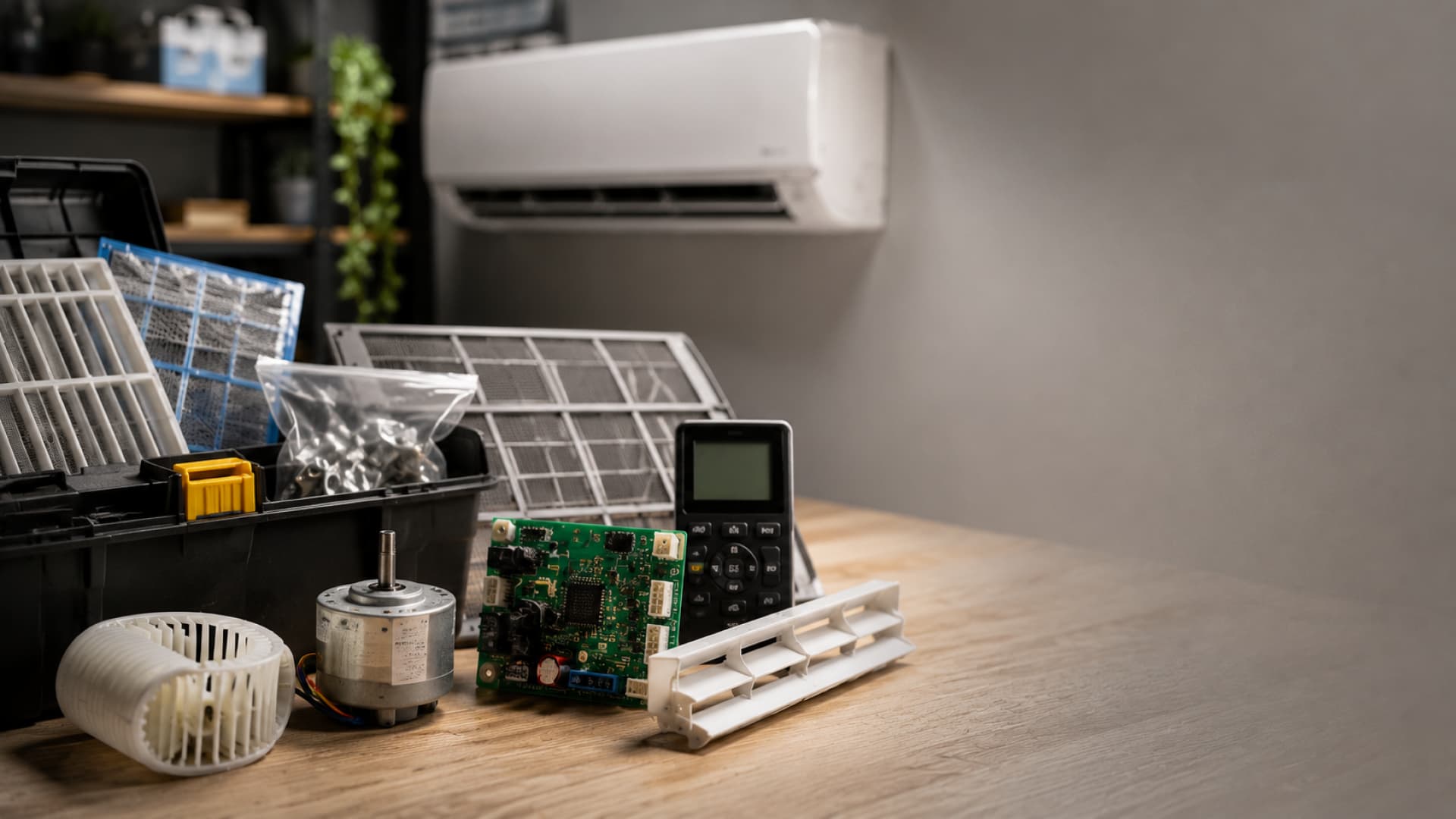
Expert Tips for Finding Aircon Spares in SA
Finding the right aircon spare is not just about matching a part that looks similar. A filter, remote, capacitor, fan motor, PCB, sensor, or compressor must match the brand, model, capacity, electrical rating, and system design of your unit.
This guide explains how to find the correct aircon spares in South Africa, what information to collect before asking for a quote, which parts are commonly replaced, and when a repair should be handled by a qualified technician instead of attempted at home.
Why the Correct Aircon Spare Matters
Air conditioners rely on matched components. If the wrong part is installed, the unit may run poorly, fail again, void its warranty, or create an electrical or refrigerant safety risk.
A correct spare helps with three things:
- Compatibility: The part is designed to work with your exact brand and model.
- Performance: The aircon can operate as close as possible to its intended cooling, heating, airflow, and noise levels.
- Reliability: The repair is less likely to create repeat faults or damage related parts.
This matters most with components such as PCBs, fan motors, compressors, sensors, expansion valves, capacitors, and remote controllers. Many parts look similar across brands, but the internal ratings and control logic can differ.
For simple parts such as filters or remote controllers, compatibility is still important. A filter that does not seat correctly can allow dust onto the evaporator coil. A remote that is not matched to the unit may only control basic functions or may not work at all.
What Information Do You Need Before Looking for Aircon Spares?
Before contacting a supplier, installer, or service team, collect as much information as possible from the aircon itself. This prevents guesswork and speeds up the quote process.
| Information needed | Where to find it | Why it matters |
|---|---|---|
| Brand | Indoor or outdoor unit label | Parts are usually brand-specific |
| Model number | Data plate on indoor or outdoor unit | Confirms exact spare compatibility |
| Serial number | Data plate or installation paperwork | Helps confirm production batch or variant |
| BTU / capacity | Product label, invoice, or manual | Parts can differ between 9,000, 12,000, 18,000 and 24,000 BTU units |
| Indoor or outdoor part | Fault location | Indoor and outdoor components differ completely |
| Photos of the faulty part | Take clear photos before removal | Helps identify part shape, terminals, plugs, and markings |
| Fault symptoms | What the unit is doing or not doing | Helps confirm whether the suspected part is actually the issue |
Take a photo of the full unit label, not just the brand logo. The model number is usually a combination of letters and numbers and may appear on both the indoor and outdoor unit.
If the unit was bought through AC Direct, also provide your order number or invoice details if available.
Common Aircon Spares and What They Do
Different faults point to different possible parts. The table below gives a practical overview, but it is not a replacement for diagnosis by a technician.
| Spare part | What it does | Common warning signs |
|---|---|---|
| Air filter | Captures dust before air reaches the indoor coil | Weak airflow, dusty smell, visible dirt, poor cooling |
| Remote controller | Sends mode, temperature and fan commands to the indoor unit | Unit does not respond, missing functions, damaged remote |
| Capacitor | Helps certain motors start and run correctly | Fan not starting, humming, intermittent operation |
| Fan motor | Moves air across the indoor or outdoor coil | No airflow, vibration, unusual noise |
| PCB / control board | Controls the unit’s electronics and communication | Error codes, no power response, irregular behaviour |
| Temperature sensor | Measures room or coil temperature | Incorrect temperature reading, short cycling |
| Drain pipe or drain components | Removes condensate water from the indoor unit | Water dripping indoors, damp wall below the unit |
| Louvre or swing motor | Controls airflow direction |
Some of these parts are simple to inspect. Others are not. Anything involving refrigerant, electrical diagnosis, PCB replacement, compressor work, or sealed-system repairs should be handled by a qualified technician.
Genuine, Compatible, or Generic Parts: Which Should You Use?
The safest option is a genuine or manufacturer-approved spare. It is designed for the specific unit and is the least likely to cause compatibility problems.
Compatible parts may be suitable in some cases, especially for older units where original spares are unavailable. However, compatibility should be confirmed by a professional supplier or technician, not guessed from appearance alone.
Generic parts are risky for technical components. They may work for basic items such as some drain fittings or mounting accessories, but they should not be used blindly for electrical boards, motors, compressors, sensors, or refrigerant-side components.
A cheap part is not a saving if it causes a second callout, damages another component, or fails shortly after installation.
How to Keep Aircon Spare Costs Under Control
The best way to keep aircon spare costs affordable is to avoid guesswork. Buying the wrong part, fitting a part before the fault is diagnosed, or using an incompatible generic component can turn a simple repair into a repeat callout.
If you are trying to manage repair costs, focus on these decisions first:
| Cost-control step | Why it helps |
|---|---|
| Confirm the exact model number | Prevents buying a part that fits a different unit in the same brand range |
| Diagnose the fault before ordering | Avoids replacing a part that is only showing a symptom |
| Check whether the unit is still under warranty | Protects you from unauthorised work that may affect a claim |
| Compare repair cost with replacement value | Helps avoid overspending on an old or badly corroded unit |
| Maintain the unit regularly | Reduces avoidable failures caused by dust, blocked drainage or poor airflow |
Affordable aircon spares are useful when they are correctly matched to the unit and fitted for the right reason. They are risky when price becomes the only deciding factor.
Can You Replace Aircon Spares Yourself?
You can usually handle basic user-level maintenance, but most repairs should be left to a technician.
Usually safe for the user
You can normally clean or replace the following if your model is designed for user access:
- Washable indoor filters
- Remote batteries
- Some remote controllers
- Basic front-panel cleaning
- Clearing leaves and debris around the outdoor unit
Always switch the unit off before opening the front panel or cleaning around it.
Technician-only work
Call a qualified technician for:
- Electrical components
- PCB replacement
- Fan motor replacement
- Compressor replacement
- Refrigerant leaks
- Pressure testing
- Coil repairs
- Error-code diagnosis
- Water leaks that continue after basic drain checks
Refrigerant work is not a DIY job. It requires the correct tools, training, and handling process. Electrical repairs also carry real safety risks, especially on inverter units.
How to Know Whether a Repair Is Worth It
A spare part makes sense when the aircon is still relatively young, the fault is isolated, and the rest of the unit is in good condition.
Repair becomes less attractive when:
- The unit is very old
- Multiple parts are failing
- The compressor has failed
- The outdoor coil is badly corroded
- The unit uses outdated or hard-to-source parts
- The repair cost is close to the cost of replacing the unit
- The aircon was incorrectly sized for the room from the start
As a practical rule, start with diagnosis before buying parts. Replacing a suspected spare without confirming the actual fault can waste money. For example, weak cooling may be caused by a dirty coil, low refrigerant, incorrect sizing, poor installation, a blocked filter, or a failing component. The spare depends on the cause.
How AC Direct Can Help You Find the Right Aircon Spare
AC Direct can assist with identifying aircon spares when you provide the correct unit details. The more information you share upfront, the faster the team can check availability or advise whether a technician should inspect the unit first.
Before enquiring, prepare:
- Brand and model number
- Indoor and outdoor unit photos
- Serial number if visible
- Description of the fault
- Error code if shown
- Photos of the broken part
- Original invoice or order number if bought through AC Direct
For spares enquiries, use the aircon spares page. For repairs, water leaks, electrical faults, refrigerant issues, or uncertain diagnosis, book a service instead. This keeps the process practical: identify the correct part first, then decide whether supply-only or technician-assisted repair is the safer route.
Tips to Avoid Buying the Wrong Aircon Spare
Do not rely only on the brand name. A Samsung, Midea, LG, Alliance, Hisense, Daikin, or other branded unit may have multiple model variants with different parts.
Avoid these common mistakes:
- Buying by appearance only: Two parts can look the same but have different ratings or connectors.
- Using the indoor model only: Some repairs need the outdoor model number too.
- Ignoring BTU size: Parts can differ between capacities in the same range.
- Skipping diagnosis: The visible fault may be a symptom, not the failed part.
- Forgetting warranty status: If the unit is still under warranty, unauthorised repair attempts can create claim issues.
- Using incompatible remotes: Some universal remotes only control basic functions and may not support all modes.
When in doubt, send photos and ask before ordering.
Maintenance Reduces the Need for Spares
The best way to reduce spare-part spend is to maintain the aircon properly. Many faults start with dirt, blocked airflow, poor drainage, corrosion, or neglected servicing.
Good habits include:
- Cleaning indoor filters regularly
- Keeping the outdoor unit clear of leaves and debris
- Booking an annual professional service
- Checking drainage before summer
- Fixing water leaks early
- Avoiding operation when ice appears on the unit
- Servicing coastal units more carefully due to salt-air corrosion
Routine maintenance will not prevent every fault, but it reduces avoidable failures and helps small issues get caught before they damage expensive components.
Internal Links
- Full aircon maintenance checklist
- Samsung aircon maintenance checklist
- Aircon repair vs replace: how to decide
- Browse air conditioners
- Aircon spares enquiries
FAQ: Aircon Spares in South Africa
Where can I find aircon spares near me?
The safest way to find aircon spares near you is to start with the unit’s brand and model number, then contact a supplier that can check compatibility before quoting. AC Direct can assist with aircon spare enquiries when you provide the unit label, photos, fault description, and the part you need. Do not buy by appearance alone, especially for electrical or control parts.
What information do I need before asking for an aircon spare?
You need the brand, model number, serial number if available, BTU capacity, photos of the indoor and outdoor unit labels, and a clear description of the fault. Photos of the faulty part are also useful if it has already been removed by a technician. This information helps confirm compatibility and reduces the chance of ordering the wrong spare.
Can I replace aircon spares myself?
You can usually clean filters, replace remote batteries, and do basic user-level maintenance yourself. Electrical parts, PCBs, fan motors, compressors, refrigerant components, and leak repairs should be handled by a qualified technician. Incorrect installation can damage the aircon or create a safety risk.
Are affordable aircon spares worth buying?
Affordable aircon spares are worth buying only if they are compatible, reliable, and suitable for the exact unit. The cheapest part is not always the best value if it fails quickly or causes another fault. For technical components, prioritise correct fitment and supplier guidance over price alone.
Should I repair my aircon or replace it?
Repair is usually sensible when the unit is still in good condition and the fault is limited to one replaceable part. Replacement may be better if the unit is old, inefficient, badly corroded, incorrectly sized, or facing a major compressor or PCB failure. A technician can diagnose the fault and help compare the repair cost against replacement value.
Help Article: How to Identify the Correct Aircon Spare
Short-form guide | 3 min read | Category: Product Help → Maintenance
Before ordering an aircon spare, confirm the exact part needed. Guessing from appearance can lead to the wrong part, repeat faults, or wasted callout costs.
Step 1: Find the model number
Look for the data label on the indoor unit and outdoor unit. It is usually on the side, base, or behind a panel. Take a clear photo of the full label.
Step 2: Note the fault
Write down what the aircon is doing. Examples include: no cooling, weak airflow, water dripping inside, remote not responding, outdoor unit not starting, error code showing, or unusual noise.
Step 3: Photograph the part
If a technician has identified or removed the faulty part, take photos of the part from multiple angles. Include connectors, labels, printed numbers, and any damage.
Step 4: Check warranty status
If the unit may still be under warranty, do not attempt unauthorised repairs. Keep the invoice and service history ready.
Step 5: Ask before ordering
Send the model number, serial number, part photos, and fault description to AC Direct. If the fault has not been diagnosed yet, book a service before ordering parts.
Related: Full aircon maintenance checklist | Aircon spares enquiries | Book an aircon service