


Commercial Air Conditioning for Workspaces
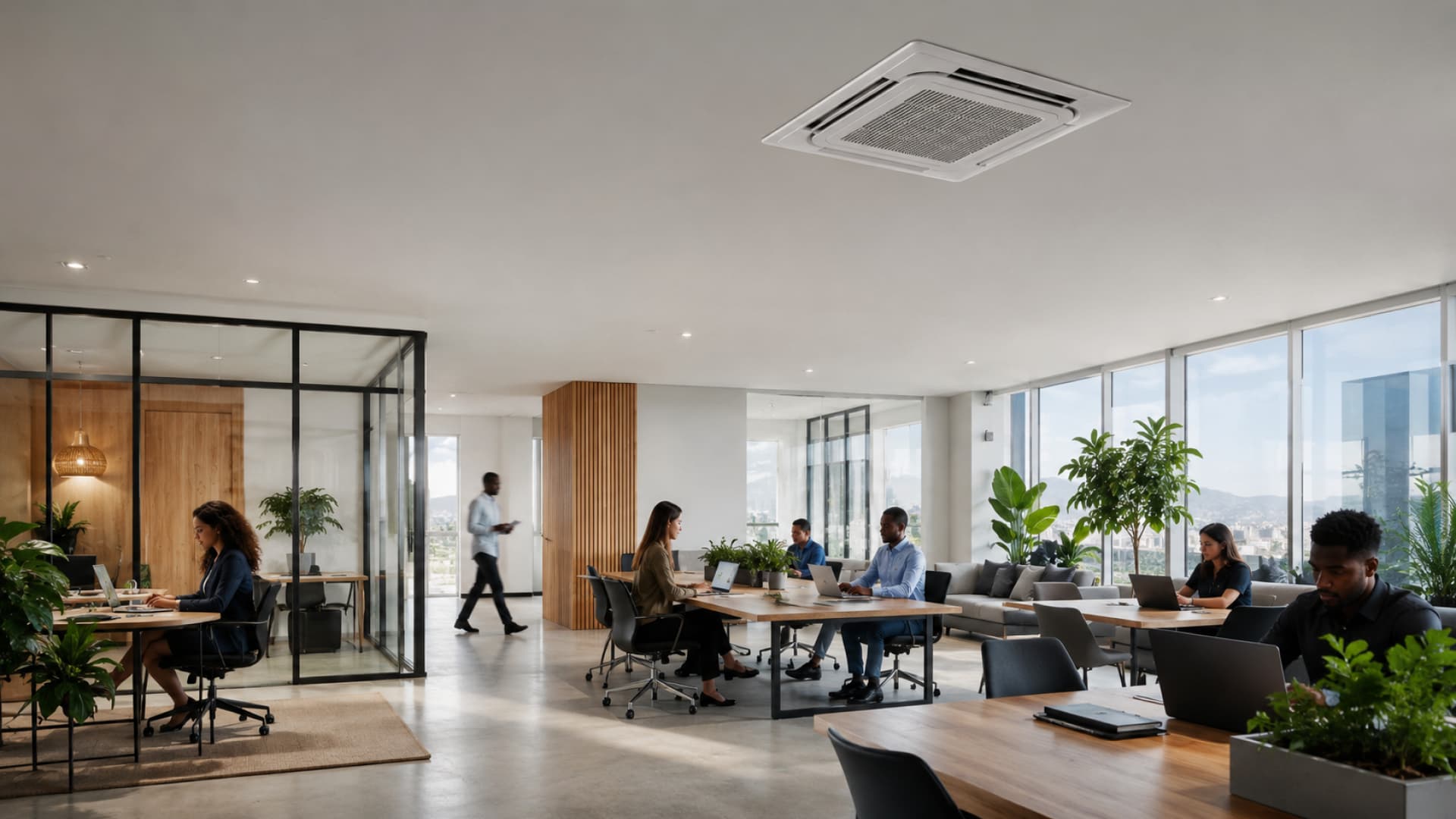
Commercial Air Conditioning for Workspaces
A hot, stuffy office is uncomfortable. A hot warehouse or factory can become a safety, productivity and equipment problem. The right commercial air conditioning system helps keep people, products and machinery within a more stable working environment — especially in South African summers where heat, dust and humidity can make indoor spaces difficult to manage.
This guide explains how commercial aircon benefits offices, warehouses and factories, what system types to consider, and how to choose a solution that suits your space instead of simply buying the biggest unit available.
Why Commercial Air Conditioning Matters
Commercial air conditioning is not only about making a room feel cooler. In a business setting, temperature control affects how people work, how equipment performs, how stock is stored, and how customers experience your premises.
A small office, a large warehouse and a production floor all have different cooling needs. An office may need quiet comfort and neat ceiling integration. A warehouse may need high airflow over a larger open space. A factory may need cooling that works around heat-producing equipment, dust, shift patterns and ventilation requirements.
| Workspace | Main aircon challenge | What the system needs to manage |
|---|---|---|
| Office | Comfort, noise and client-facing appearance | Quiet operation, even airflow, zoning and neat installation |
| Warehouse | Large volume of air and changing door traffic | High airflow, correct capacity, practical positioning and ventilation support |
| Factory | Heat from people, machinery and process areas | Load assessment, durable equipment, planned maintenance and safety-conscious design |
| Retail / showroom | Customer comfort and product presentation | Consistent temperature, discreet placement and efficient running costs |
| Boardroom / meeting area | Occupancy changes throughout the day | Fast response, quiet operation and flexible control |
The goal is not to freeze the building. The goal is to create a controlled environment that stays comfortable, practical and cost-aware during real business use.
Benefit 1: Better Comfort and Productivity
People work better in a space that is not excessively hot, cold, humid or stuffy. In an office, poor temperature control can make it harder for staff to focus. In a warehouse or factory, high heat can increase fatigue, reduce pace and make physical work less safe.
Commercial aircon helps by keeping the indoor climate more consistent. That matters during heatwaves, high-humidity coastal conditions, dry inland summers and busy production periods where machinery and people add extra heat to the building.
For offices, this usually means quiet, steady cooling across workstations, boardrooms and reception areas. For warehouses and factories, it may mean targeted cooling for work zones, dispatch areas, packing stations, control rooms, server-adjacent spaces or temperature-sensitive storage zones.
The practical win is consistency. A system that maintains comfort steadily is better than one that blasts cold air into one corner while the rest of the building stays uncomfortable.
Benefit 2: Safer Conditions in Hot Workspaces
Warehouses and factories can become significantly hotter than the outdoor temperature, especially where there is metal roofing, poor insulation, frequent door opening, machinery heat, forklifts, lighting, packaging lines or high staff movement.
Commercial air conditioning can help reduce heat stress risk by lowering indoor temperatures and improving air movement. It is not a replacement for workplace safety planning, ventilation design, hydration breaks or legal compliance, but it is often part of a safer heat-management strategy.
For physically active teams, the aircon design should consider where people actually work. Cooling an empty high roof space while staff remain hot on the floor is poor design. The better approach is to assess the working zones, heat sources, airflow paths and operating hours before selecting the equipment.
Benefit 3: Improved Air Quality and Dust Control
Air conditioning can support better indoor air quality by filtering recirculated air and helping control humidity. This is especially useful in South African commercial spaces where dust, pollen, packaging particles, traffic pollution or coastal humidity can affect indoor comfort.
That said, an aircon is not the same as a full ventilation or air-purification system. It should be chosen and maintained correctly. Filters must be cleaned or replaced on schedule, condensate drains must remain clear, and indoor coils must be serviced so the system does not become a source of odour or poor airflow.
In offices, cleaner filtered air can make the workspace feel fresher. In warehouses and factories, the benefit depends heavily on the environment. Dust-heavy operations may need more frequent filter maintenance, stronger ventilation planning or additional extraction systems alongside air conditioning.
Benefit 4: Protection for Equipment and Stock
Some equipment and inventory are sensitive to heat, humidity or unstable temperature. Electronics, adhesives, packaging materials, stored appliances, certain foods, cosmetics, documents, labels and machine control systems can all be affected by poor climate control.
Commercial air conditioning helps stabilise the environment around these assets. In a warehouse, that may protect stock from heat buildup. In an office, it may protect IT equipment, server cupboards or boardroom AV equipment. In a factory, it may help prevent overheating in control rooms or staff areas near production heat.
This does not mean every warehouse must be cooled wall-to-wall. Sometimes the best solution is zone cooling: protect the areas where temperature matters most rather than cooling the entire building volume unnecessarily.
Commercial systems also need to protect the building's working infrastructure. Control panels, electrical rooms, server-adjacent areas, machinery controls and stock-handling zones can all suffer when heat builds up. A good design looks at people, equipment and airflow together, rather than treating cooling as a single-room comfort upgrade.
Benefit 5: Better Customer and Client Experience
If clients, suppliers or customers visit your premises, the indoor climate affects how professional the space feels. Reception areas, showrooms, waiting rooms and meeting spaces should feel controlled and comfortable, not hot, humid or stale.
For customer-facing businesses, air conditioning is part of the experience. It gives people a reason to stay longer, view products properly and sit through discussions without discomfort. In a showroom, a stable indoor temperature can also protect display stock and keep the space feeling premium.
Benefit 6: Energy Control When the System Is Designed Properly
Commercial air conditioning can use a lot of electricity if it is poorly sized, badly positioned or run without controls. But a well-designed system can be more efficient than a patchwork of undersized units running flat out all day.
The biggest energy factors are:
- Correct capacity for the space and heat load
- Inverter technology where suitable
- Zoning, so unused areas are not cooled unnecessarily
- Timers and programmable controls
- Good insulation and door management
- Regular filter and coil maintenance
- Outdoor unit positioning with proper airflow
A commercial system should be designed around how the building is used. A warehouse with roller doors opening all day has a different heat load from a sealed office with insulated ceilings. A factory with machinery heat needs a different approach from a boardroom that is only full twice a day.
If energy use is a concern, start with a proper load assessment and zoning plan before choosing equipment.
Which Commercial Aircon Type Should You Choose?
Different commercial aircon systems solve different problems. The right choice depends on ceiling height, room layout, aesthetics, airflow needs, service access and whether you need to cool one zone or multiple areas.
| System type | Best suited to | Main advantage | Watch out for |
|---|---|---|---|
| Under-ceiling aircon | Warehouses, halls, larger open rooms | Strong airflow without using floor space | Must be positioned to avoid direct draughts over staff |
| Cassette aircon | Offices, shops, reception areas, boardrooms | Neat ceiling-mounted look with multi-directional airflow | Requires ceiling void and proper condensate drainage |
| Ducted aircon | Multi-room offices or larger fitted spaces | Hidden installation and centralised distribution | Needs duct design, ceiling space and careful balancing |
| Wall-split aircon | Small offices, server-adjacent rooms, admin areas | Cost-effective and simple for single zones | Not ideal as the only solution for large open spaces |
| Multiple-zone system | Buildings with separate work areas | Better control per area | Needs proper design to avoid uneven comfort |
For larger or complex sites, do not choose from room size alone. Commercial spaces need a load calculation that considers roof height, insulation, sun exposure, equipment heat, staff count, door opening patterns and operating hours.
Office Air Conditioning: What Matters Most?
Office air conditioning should be quiet, predictable and easy to control. Staff should not have to fight over the remote, and the system should not blow directly onto desks all day.
Good office design usually prioritises:
- Even airflow across workstations
- Low indoor noise levels
- Zoning for boardrooms, reception and open-plan areas
- Timers for business hours
- Clean installation with accessible service points
- Outdoor units placed where noise and heat discharge are managed
Boardrooms need special attention because occupancy changes quickly. A room that is comfortable for two people may heat up fast when 10 people, laptops and presentation equipment are added. This is where correct sizing and airflow placement make a real difference.
Warehouse Air Conditioning: What Matters Most?
Warehouse cooling is usually less about luxury comfort and more about practical temperature management. The challenge is air volume. High ceilings, roller doors, loading bays and poor roof insulation can make a warehouse difficult to cool with standard residential thinking.
Before choosing a system, consider:
- Whether the full warehouse needs cooling or only selected work zones
- How often doors open during operating hours
- Roof height and insulation
- Staff working positions
- Stock sensitivity to heat or humidity
- Ventilation requirements
- Whether fans, extraction or evaporative cooling support is needed alongside air conditioning
In many warehouses, targeted cooling can be more practical than trying to condition the full space. Cooling offices, picking stations, packing benches and control areas may deliver more value than attempting to cool every cubic metre of air.
Factory Air Conditioning: What Matters Most?
Factories need a more careful assessment because production environments create their own heat, dust and airflow challenges. Machinery, ovens, compressors, people, packaging lines and lighting can all add to the cooling load.
A factory aircon plan should consider:
- Process heat from machinery or production areas
- Dust, fibres, packaging particles or fumes
- Shift patterns and operating hours
- Maintenance access around equipment
- Electrical load availability
- Staff safety and comfort zones
- Whether cooling must protect a product, a process or only occupied areas
Air conditioning should never be treated as a standalone fix for every factory condition. It may need to work with extraction, ventilation, insulation and operational changes. For technical areas, a site assessment is the right starting point.
Maintenance: How Often Should Commercial Aircons Be Serviced?
Commercial air conditioning systems work harder than most residential units. They often run longer hours, serve more people and operate in dustier environments. That means maintenance cannot be an afterthought.
As a practical rule, many commercial systems should be checked at least twice a year — usually before summer and before winter. High-use, dusty, coastal or production environments may need more frequent filter cleaning and scheduled inspections.
| Task | Typical frequency | Why it matters |
|---|---|---|
| Filter cleaning or replacement | Monthly to quarterly, depending on dust and use | Protects airflow, efficiency and indoor air quality |
| Outdoor unit clearance check | Monthly | Prevents airflow restriction and overheating |
| Drain line inspection | Every service | Reduces leak and odour risk |
| Coil cleaning | At least annually, more often in harsh environments | Maintains heat exchange efficiency |
| Electrical inspection | At least annually | Reduces fault, nuisance trip and safety risks |
| Full professional service | Usually twice a year for commercial use | Keeps the system reliable under business-hour loads |
Neglected maintenance can turn a good system into an expensive one. Dirty filters and coils force the system to work harder, increase noise, reduce comfort and shorten equipment life.
How to Choose the Right Commercial Air Conditioning System
Start with the building, not the product catalogue. A good commercial aircon decision starts with how the space is used.
Before requesting a quote, prepare the following:
- The floor area and ceiling height of each zone
- The number of people working in the area
- Normal operating hours
- Heat-generating equipment or machinery
- Door opening patterns, especially roller doors or loading bays
- Ceiling type and available ceiling void
- Existing electrical capacity
- Whether the space is office, warehouse, factory, retail or mixed-use
- Any stock or equipment that is sensitive to temperature or humidity
From there, AC Direct can help narrow the system type, capacity, placement and installation approach. For straightforward small offices, the answer may be a wall split or cassette. For bigger sites, it may be under-ceiling, ducted, multiple zones or a combination of systems.
Also check the long-term support side before committing. Commercial air conditioning is business infrastructure, so spare availability, service access, installer experience, maintenance planning and after-sales support matter as much as the unit brand.
Internal Links
- Browse commercial air conditioning
- Under-ceiling air conditioners
- Cassette air conditioners
- Ducted air conditioners
- What size aircon do I need?
FAQ: Commercial Air Conditioning in South Africa
What is commercial air conditioning?
Commercial air conditioning is climate control designed for larger or more demanding spaces such as offices, warehouses, factories, retail stores and showrooms. These systems are usually selected around capacity, airflow, zoning, operating hours and installation access rather than simple bedroom-style room sizing. The right system depends on the heat load and layout of the building.
Why is air conditioning important in a warehouse?
Air conditioning is important in a warehouse because it helps control heat, protect staff comfort and reduce temperature-related risk to stock or equipment. Warehouses often have high ceilings, large doors and poor insulation, so the system must be chosen carefully. In many cases, targeted cooling for work zones is more practical than cooling the entire building.
Can commercial air conditioning improve air quality?
Yes, commercial air conditioning can help improve indoor air quality by filtering recirculated air and supporting humidity control. The result depends on the filter type, maintenance schedule and the working environment. Dust-heavy spaces may need more frequent filter cleaning and additional ventilation or extraction.
Are commercial air conditioning systems energy efficient?
Commercial air conditioning systems can be energy efficient when they are correctly sized, properly installed and maintained regularly. Inverter technology, zoning, timers and good outdoor-unit airflow all help reduce wasted electricity. A poorly sized system can still waste power, even if the unit itself has efficient technology.
How often should commercial air conditioning systems be maintained?
Most commercial air conditioning systems should be professionally serviced at least twice a year. Heavy-use, dusty, coastal or production environments may need more frequent filter checks and inspections. Regular maintenance protects airflow, efficiency, reliability and indoor air quality.
How do I choose the right commercial air conditioning system?
Choose the right commercial air conditioning system by assessing the space size, ceiling height, occupancy, equipment heat, operating hours, airflow needs and installation constraints. Small offices may suit wall splits or cassettes, while warehouses and factories often need under-ceiling, ducted or zone-based solutions. A site assessment is recommended for large or mixed-use spaces.
Help Article: How to Choose Commercial Air Conditioning (Quick Reference)
Short-form guide | 3 min read | Category: Product Help → Air Conditioning
Choosing commercial air conditioning starts with understanding the space. A warehouse, factory, office and showroom all need different airflow, capacity and control.
Step 1: Define the area you need to cool
List each zone separately. Include offices, boardrooms, reception areas, warehouse work zones, packing areas, factory floors and server-adjacent rooms. Do not assume one large unit is always better than multiple controlled zones.
Step 2: Check the heat load
Consider ceiling height, sun exposure, insulation, people, equipment, computers, machinery, lighting and door opening patterns. These factors often matter more than floor area alone.
Step 3: Choose the system type
- Use wall splits for smaller offices and single rooms.
- Use cassettes for neat office or retail cooling.
- Use under-ceiling units for larger open spaces.
- Use ducted systems where hidden, multi-room cooling is needed.
- Use a zone-based design for mixed-use buildings.
Step 4: Plan for maintenance access
Make sure filters, drains, indoor units and outdoor units can be reached for service. A system that is difficult to maintain will usually become expensive to own.
Step 5: Confirm with a specialist
For warehouses, factories and multi-zone offices, request a proper assessment before ordering. Commercial cooling is too important to size by guesswork.
Related: Full commercial air conditioning guide | Browse commercial air conditioning