


Hot Water Heat Pumps: SA Geyser Guide
Hot Water Heat Pumps: SA Geyser Guide
A hot water heat pump can reduce the electricity used for water heating by moving heat from the surrounding air into your water instead of generating heat directly with an electric element. For South African homes where the geyser is one of the biggest daily electricity loads, that can make a real difference.
This guide explains how hot water heat pumps work, how they compare with conventional electric geysers and solar water heating, what size to consider, and when the investment makes sense for a home, guesthouse, office or small commercial building.
What Is a Hot Water Heat Pump?
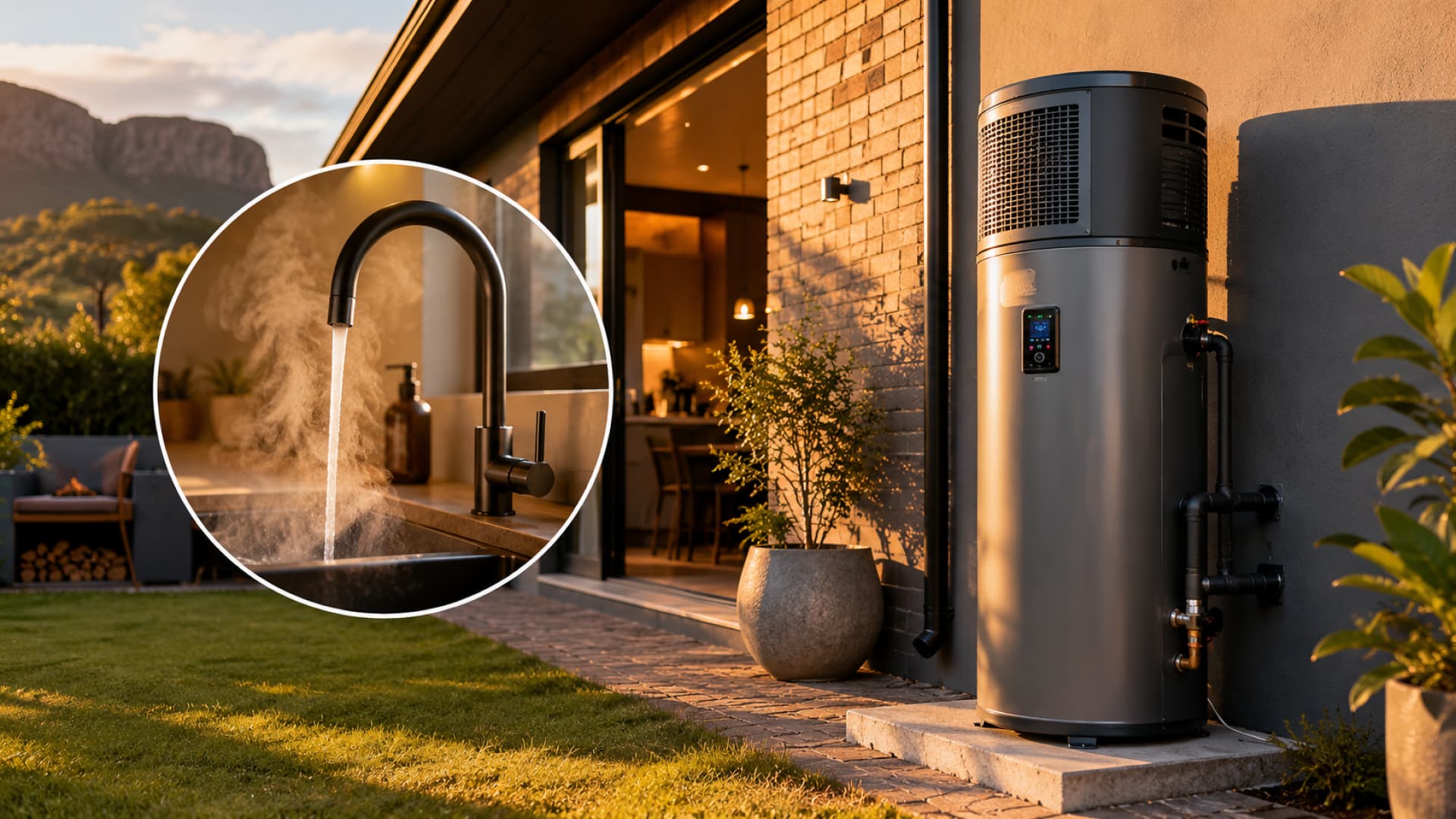
A hot water heat pump is a water-heating system that uses electricity to transfer heat rather than create heat from scratch. It pulls heat from the surrounding air, concentrates that heat through a refrigeration cycle, and transfers it into the water stored in a tank.
The easiest way to understand it is to compare it with an air conditioner working in reverse. An air conditioner removes heat from a room and rejects it outside. A hot water heat pump collects heat from the air and puts that heat into water.
A typical domestic setup includes:
| Component | What it does |
|---|---|
| Heat pump unit | Extracts heat from the surrounding air and transfers it into the water |
| Storage tank | Holds the hot water for bathrooms, kitchens and laundry use |
| Circulation pump and pipework | Moves water between the tank and heat pump, depending on system design |
| Controller | Sets temperature, timing and operating mode |
| Backup element, where fitted | Helps during high-demand periods or system backup, depending on setup |
Some systems are designed as a full replacement for an electric geyser. Others work alongside an existing geyser to reduce how often the electric element needs to run. The right setup depends on your current geyser, plumbing layout, roof or outside space, household size and hot-water usage pattern.
How Does a Hot Water Heat Pump Work?
A hot water heat pump uses a refrigeration cycle to move heat. It does not need hot weather to operate, but warmer surrounding air usually helps it run more efficiently.
In simple terms, the process works like this:
- A fan draws air across an evaporator coil.
- Refrigerant inside the coil absorbs heat from the air.
- The compressor raises the refrigerant temperature.
- The hot refrigerant passes through a heat exchanger.
- Heat transfers into the stored water.
- The cooled refrigerant returns through the system and the cycle repeats.
Because the unit is moving heat rather than generating heat directly, it can deliver more heat energy into the water than the electrical energy it consumes. The efficiency is usually described as COP, or coefficient of performance. A COP of 3 means the unit delivers about three units of heat for every one unit of electricity used, under the test conditions for that rating.
That does not mean every installation saves the same amount. Real performance depends on installation quality, ambient temperature, water usage, set temperature, pipe insulation, tank standing losses and whether the system is sized correctly.
Hot Water Heat Pump vs Electric Geyser
A standard electric geyser uses an electrical element inside the tank. It is simple and familiar, but it converts electricity directly into heat. A hot water heat pump uses electricity mainly to run the compressor, fan and controls while collecting heat from the air.
| Factor | Electric geyser | Hot water heat pump |
|---|---|---|
| Heating method | Electric element creates heat directly | Transfers heat from surrounding air into water |
| Upfront cost | Usually lower | Usually higher |
| Running cost | Usually higher for regular hot-water use | Usually lower when correctly sized and installed |
| Best fit | Low-use homes, tight upfront budgets, simple replacements | Homes or businesses with regular hot-water demand |
| Installation needs | Standard plumbing and electrical setup | Plumbing, airflow, positioning and system matching |
| Efficiency | Limited by electric resistance heating | Often significantly more efficient than resistance heating |
| Backup | Element heats directly | May include or work with backup element, depending on system |
For a household that uses very little hot water, the upfront cost of a heat pump may take longer to justify. For a family home, guesthouse, staff facility, salon, small lodge or business with regular hot-water demand, the running-cost reduction can become more important than the initial purchase price.
The key is not to buy a heat pump because it sounds efficient. The key is to match the system to how much hot water you actually use.
Hot Water Heat Pump vs Solar Geyser
Solar geysers and hot water heat pumps both aim to reduce reliance on a conventional electric element, but they do it in different ways.
A solar water heater uses sunlight directly. That can work extremely well when roof direction, roof space and sun exposure are favourable. A heat pump uses electricity to extract heat from the surrounding air, so it can operate day or night, although performance is affected by ambient conditions.
| Option | Strengths | Watch-outs |
|---|---|---|
| Solar geyser | Very low running cost in good sun conditions | Weather dependent, roof dependent, may need electric backup |
| Hot water heat pump | Controlled heating, works day or night, no roof collector required | Needs electricity, airflow and correct placement |
| Electric geyser | Simple, familiar and lower upfront cost | Higher running cost for regular use |
A heat pump can be attractive when roof space is limited, the roof direction is poor, the home has shading, or the customer wants a more controllable water-heating solution. Solar may be attractive where roof conditions are excellent and the goal is maximum use of direct solar energy.
Some properties use more than one technology. For example, a solar PV system can help power a heat pump during the day, or a heat pump can be part of a broader energy-saving plan with timers, insulation and smart load control.
Where Hot Water Heat Pumps Make the Most Sense
Hot water heat pumps are strongest where the water-heating load is high enough to justify the investment. They are not only for large homes, but they work best when there is regular, predictable hot-water use.
Good use cases include:
- Family homes with multiple showers per day
- Homes where the electric geyser is a major part of prepaid electricity usage
- Guesthouses and small lodges
- Staff bathrooms and change rooms
- Salons, clinics and wellness spaces
- Small commercial facilities with regular hot-water demand
- Properties trying to reduce pressure on an electric geyser
They may be less suitable where hot-water demand is very low, where there is no good installation position, or where the budget only allows for a basic geyser repair. A heat pump also needs space with suitable airflow. It should not be boxed into a cramped, sealed cupboard unless the system has been designed for that installation.
Choosing the Right Size
Sizing is one of the most important decisions. A heat pump that is too small may take too long to recover after heavy use. A system that is too large can cost more than necessary.
Start with the number of people, the number of bathrooms, shower habits, bath usage, laundry use and whether the system serves a home or business.
| Property type | Common starting point | What to check |
|---|---|---|
| 1 to 2 people, light use | 100 to 150 L tank | Shower length, kitchen use and recovery time |
| Small family | 150 to 200 L tank | Morning and evening shower demand |
| Medium to larger family | 200 to 300 L tank | Multiple bathrooms and back-to-back showers |
| Guesthouse or business | Custom sizing | Peak demand, occupancy and recovery requirement |
This is an indicative guide only. Final sizing should be confirmed against real usage and the heat pump model’s recovery performance. Two homes with the same number of people can need different systems if one uses short showers and the other uses baths, multiple bathrooms and high evening demand.
For a replacement project, check the current geyser size and whether the household regularly runs out of hot water. If the current geyser is already too small, replacing it with the same storage volume may not solve the comfort problem.
What Affects Running Cost and Payback?
A hot water heat pump usually costs more upfront than a basic electric geyser replacement, so the decision should be made using total cost of ownership rather than purchase price alone.
The payback period depends on:
- Current water-heating electricity use
- Household size and hot-water demand
- Electricity tariff or prepaid rate
- Installed cost of the heat pump system
- Whether the existing geyser needs replacement anyway
- Climate and installation conditions
- Set temperature and timer settings
- Pipe and tank insulation
- Maintenance and service costs
Use this simple calculation:
Monthly saving = old water-heating cost minus new water-heating cost
Payback period = extra installed cost divided by monthly saving
For example, if a heat pump upgrade costs more than a standard geyser replacement, the payback is based on the extra amount spent, not only the full project cost. If the existing geyser is old and due for replacement anyway, the comparison changes because some cost would have been spent regardless.
Avoid fixed promises such as “this pays for itself in X months” unless the customer’s electricity use and installed cost have been assessed. A household with heavy hot-water use may recover the difference faster than a small household with low usage.
Installation Considerations
A hot water heat pump needs more planning than a basic like-for-like geyser replacement. The unit needs access to air, service clearance, suitable plumbing routes and safe electrical work.
Before installation, check:
- Where the heat pump unit will stand or mount
- Whether the unit has enough airflow
- Distance between the tank and heat pump
- Pipe insulation to reduce heat loss
- Drainage for condensate, where applicable
- Noise sensitivity near bedrooms or neighbours
- Electrical supply and isolator requirements
- Access for future servicing
- Whether the existing geyser tank is suitable for reuse
Noise is normally manageable, but placement matters. Avoid putting the unit directly outside a bedroom window if another practical location exists. Also avoid placing it in a confined space where it will recirculate its own cold discharge air.
For businesses and guesthouses, installation should be designed around peak demand. The system must be able to recover fast enough between usage periods, especially during mornings and evenings.
Maintenance and Lifespan
A hot water heat pump needs maintenance, but it should not be difficult to look after when installed correctly. The main goal is to keep airflow, water flow and electrical components in good condition.
Typical maintenance includes:
- Keeping the air intake and outlet clear
- Checking for leaves, dust or blocked airflow
- Inspecting pipe insulation
- Checking for water leaks
- Cleaning accessible filters where the model requires it
- Confirming the controller settings
- Booking professional inspection if performance drops
- Following the manufacturer’s service schedule
If the heat pump is connected to a storage tank, the tank still needs normal hot-water system care. This may include checking the pressure control valve, safety valve, sacrificial anode where applicable, and any plumbing components required by the system design.
A heat pump that is starved of airflow or ignored when faults appear will not deliver the savings expected. Efficiency depends on the system being able to breathe, circulate and control properly.
Common Mistakes to Avoid
Choosing only by tank size
Tank size matters, but recovery rate matters too. A 200 L system that recovers too slowly may frustrate a busy household. Look at both storage and heat pump output.
Assuming every home will save the same amount
Savings depend on usage. A family with heavy hot-water demand has more saving potential than one person using very little hot water.
Installing the unit in a poor airflow position
The heat pump needs air to collect heat. A cramped, enclosed or badly ventilated space can reduce performance.
Forgetting pipe insulation
Heat lost through poor pipework reduces system efficiency. Insulate hot-water pipe runs where practical.
Assuming rebates are always available
Energy incentives and rebate programmes can change. Treat any rebate as a bonus, not the foundation of the purchase decision. Confirm current availability before quoting a payback period.
Comparing only upfront price
A cheap repair or basic geyser replacement may cost less today, but a heat pump may be better value over time for high-use homes. Compare upfront cost, running cost, comfort and expected lifespan together.
Is a Hot Water Heat Pump Right for Your Home?
A hot water heat pump is worth considering if your household uses hot water daily, your electricity bill or prepaid spend is high, and you want a more efficient alternative to an electric geyser.
It is especially worth considering when:
- Your existing geyser is old or due for replacement
- You have a family home with regular showers
- You want to reduce electricity used for water heating
- You have space for proper installation
- You want controlled hot water without relying only on sunlight
- You are already planning solar, backup power or broader energy upgrades
It may not be the right first upgrade if your hot-water demand is low, your existing geyser is still efficient and well controlled, or your installation area cannot support the required airflow.
Before buying, gather your current geyser size, household hot-water usage, installation photos and electricity usage details. That gives AC Direct enough information to recommend a practical system instead of guessing.
Internal Links
- Browse hot water heat pumps
- Complete guide to solar power in South Africa
- Grid-tied vs hybrid vs off-grid solar systems
- Pool heat pumps in South Africa
- Use the Solar Wizard
FAQ: Hot Water Heat Pumps in South Africa
What are heat pumps for hot water?
Heat pumps for hot water are systems that heat stored water by moving heat from the surrounding air into a tank. They use electricity to run a compressor, fan and controls, but they do not rely only on an electric element to create heat directly. This makes them much more efficient than conventional resistance heating in many residential and light commercial applications.
Are water heat pumps good for homes?
Yes, water heat pumps can be a good choice for South African homes with regular hot-water demand. They are especially useful for families, high-use bathrooms, homes with prepaid electricity, and properties looking to reduce geyser running costs. The best result depends on correct sizing, proper airflow, insulated pipework and professional installation.
Can a hot water heat pump replace an electric geyser?
Yes, a hot water heat pump can replace or support an electric geyser, depending on the system design. Some installations use a dedicated tank and heat pump, while others integrate with an existing hot-water setup if the tank and plumbing are suitable. A technician should confirm whether the current geyser can be reused or whether a matched tank is the better option.
How do I calculate the payback period on a hot water heat pump?
Calculate payback by dividing the extra installed cost by the expected monthly saving. The monthly saving depends on how much electricity your old geyser used, your tariff, household hot-water usage and the heat pump’s real-world performance. Avoid fixed payback claims until the installed cost and electricity usage have been checked.
Help Article: How to Decide if a Hot Water Heat Pump Is Right for You
Short-form guide | 3 min read | Category: Product Help → Water Heating
A hot water heat pump is usually worth considering when your household or business uses hot water every day and the electric geyser is a noticeable part of your electricity cost.
Step 1: Check your hot-water use
Start with the number of people, bathrooms, daily showers, bath use, laundry use and peak demand times. A family home has a stronger case than a low-use property.
Step 2: Check your current geyser
Note the geyser size, age, location and whether it still meets demand. If the geyser is old, leaking, undersized or due for replacement, the heat pump comparison becomes more attractive.
Step 3: Check installation space
The heat pump unit needs airflow, service access and safe electrical and plumbing connections. Avoid sealed cupboards or cramped spaces unless the system is designed for that setup.
Step 4: Compare running cost, not only purchase price
A heat pump costs more upfront than a basic electric geyser replacement, but it can reduce water-heating electricity use. Compare the extra installed cost against the expected monthly saving.
Step 5: Confirm the system size
Do not choose only by tank size. Confirm storage volume, recovery rate, household demand and whether backup heating is needed for peak periods.
Related: Browse hot water heat pumps | Complete solar power guide